Memphis sits directly inside the high-risk zone for subterranean termites, driven by deep alluvial clay soils and high relative humidity across Shelby County. Species like the eastern subterranean termite nest…
Memphis sits directly inside the high-risk zone for subterranean termites, driven by deep alluvial clay soils and high relative humidity across Shelby County. Species like the eastern subterranean termite nest underground, sending worker castes upward through exploratory shelter tubes across concrete masonry units and brick piers. In Midtown, Cooper-Young, and Central Gardens, historic bungalows built on raised brick piers and crawlspaces allow damp soil pockets to feed colonies beneath heart-pine sills. In contrast, slab-on-grade architecture in Cordova, East Memphis, and Southwind directs termite pressure through cold joints, plumbing penetrations, and expansion cracks beneath carpet and hardwood floors. Addressing these pressure points requires deep diagnostic inspection rather than recurring blind surface sprays.
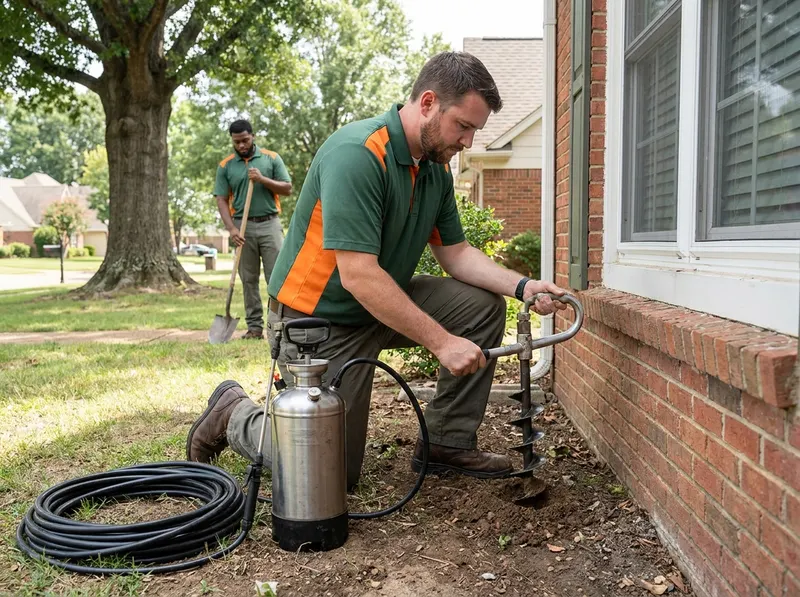
Effective defense relies on pairing structural mitigation with soil barriers tested by standard research institutions. Liquid non-repellent termiticides, such as fipronil formulations evaluated by the EPA Pesticide Programs, work through passive social transfer between foraging workers and the central nest. The solution requires trenching 6 inches wide and 6 inches deep around foundation footings, applying 4 gallons of diluted termiticide per 10 linear feet of trench. For exterior patio slabs, carports, and attached garages found throughout Berclair, Binghampton, and Hickory Hill, masonry drilling every 12 inches along expansion joints delivers product straight to subterranean void spaces. Baiting installations, calibrated according to the Entomological Society of America protocols, use cellulose matrices embedded with chitin synthesis inhibitors like noviflumuron to disrupt natural worker molting cycles over 60 to 90 days.
Homeowners weigh trenching treatments against active bait station matrices based on site drainage and landscape disruption. Trenching provides an immediate perimeter soil boundary that neutralizes workers crossing the barrier for 5 to 10 years, though tree roots, hardscaping, and utility easements near Downtown Memphis alleyways can limit continuous access. Hexagonal bait stations placed every 10 to 15 feet around the drip line require zero digging and eliminate subterranean colonies through nest collapse, but depend on systematic inspections by an accredited National Pest Management Association professional. The Tennessee Department of Agriculture regulates termiticide application concentrations, mandating exact record-keeping and label-rate volume compliance to safeguard residential groundwater and family properties.
ForestQuill Exterminators approaches subterranean termite management without long-term sales pressure or mandatory multi-year bind contracts. Every assessment inspects crawlspace joists for moisture levels above 20%, mapping exterior soil grades against siding overlaps using standards from the U.S. Department of Housing and Urban Development and the International Association of Certified Home Inspectors. Moisture conditions are cross-referenced with regional construction guidelines from the International Code Council and water-reduction protocols from the U.S. Geological Survey. When treatment completes, homeowners receive a complete treatment graph detailing linear footage, foundation penetration points, and chemical amounts applied, following consumer-protection standards supported by the Federal Trade Commission and environmental parameters from the USDA Agricultural Research Service. For inquiries or to verify foundation dimensions, homeowners can contact the office directly at (901) 749-8024.
Every job gets a firm, written price after a free on-site visit.
Tell us about your subterranean termite treatment job in Memphis and we'll send a clear, written quote, usually the same day.
 ForestQuill Exterminators