Stinging insect activity in Shelby County escalates sharply from May through October, driven by high Mississippi Valley humidity and prolonged summer temperatures exceeding 90 degrees Fahrenheit. Colonies initiate…
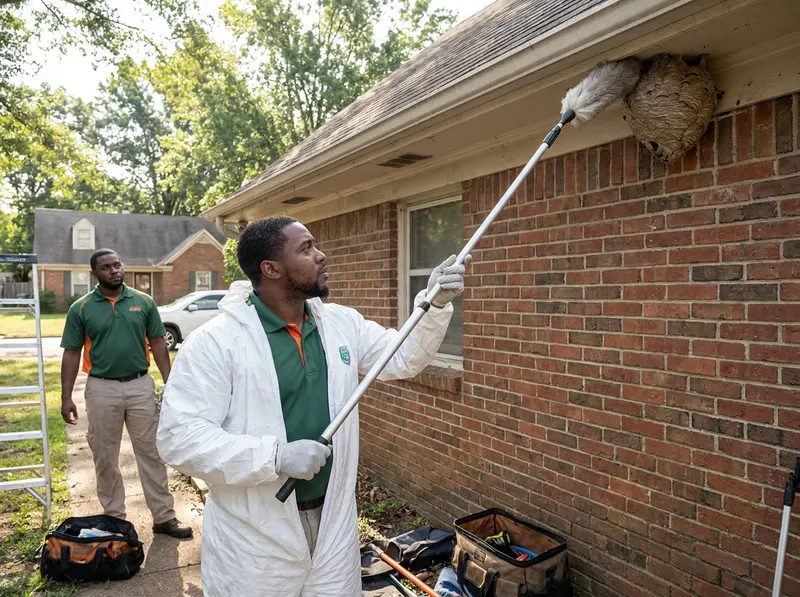
Stinging insect activity in Shelby County escalates sharply from May through October, driven by high Mississippi Valley humidity and prolonged summer temperatures exceeding 90 degrees Fahrenheit. Colonies initiate under the unpainted soffits of Craftsman bungalows in Midtown, inside the thick fascia trim of Central Gardens historic properties, and within wall weep holes along East Memphis brick ranches. Unlike solitary pollinators, social wasps and hornets defend colonies aggressively through defensive pheromone releases. Surface aerosol applications typically irritate these colonies rather than eliminating them, driving worker wasps deeper into drywall crevices, attic spaces, and soffit channels. Effective intervention requires direct liquid micro-injections or insecticidal dusts applied via calibrated equipment into the central nest matrix, targeting the queen to halt brood production.
Treatment methods depend strictly on species biology and nest architecture. Paper wasps (Polistes metricus) construct open-comb umbrella nests beneath window eaves, porch ceilings, and deck ledges, making them accessible to direct mechanical knockdown combined with a localized pyrethroid barrier. In contrast, aerial hornets build enclosed, football-sized papier-mâché nests in mature shade trees near Overton Park or beneath high second-story gables in Southwind and Cordova. Ground-nesting yellowjackets often exploit abandoned rodent tunnels or hollow landscape ties in Cooper-Young flower beds. These underground and structural-void colonies require pressurized micro-dust formulations that distribute evenly through interconnected comb tiers without drilling disruptive exploratory holes through interior living spaces.
Intervention fits situations where active flight paths enter structural voids, children or pets inhabit immediate exterior zones, or defensive swarms prevent normal access to entryways and yards. For solitary carpenter bees boring half-inch entry holes into untreated cedar siding in Binghampton or Berclair, liquid perimeter sprays prove ineffective; treatment instead demands individual gallery micro-injection followed by structural wood plugs. A standard trade-off exists regarding timing: daylight applications resolve immediate physical hazards quickly, yet evening treatments capture a higher percentage of foraging workers returning to the nest comb, substantially reducing following-day perimeter re-orientations. ForestQuill Exterminators applies targeted pyrethroid compounds strictly to nesting sites, preserving non-target garden zones and keeping chemical footprints away from pet runs and children's play areas.
Every job gets a firm, written price after a free on-site visit.
Tell us about your stinging insect removal job in Memphis and we'll send a clear, written quote, usually the same day.
 ForestQuill Exterminators